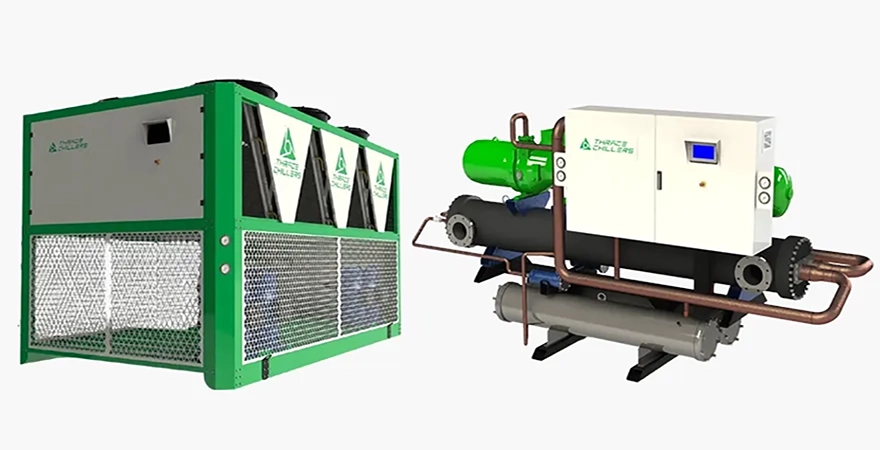
Air-Cooled and Water-Cooled Chillers Compared
An air-cooled chiller rejects heat to ambient air; a water-cooled chiller rejects it to condenser water. The latter generally requires a cooling tower or another heat-rejection system.
Technical assessment
Compare fan, pump, tower, water, treatment and maintenance costs alongside capital cost. Neither arrangement is universally more efficient or more economical for every site.
Information needed for selection
Provide the application, operating hours, cooling load, entering and leaving liquid temperatures, fluid type and concentration, flow, site location and environmental conditions. A nominal capacity alone does not replace a detailed equipment selection.
Frequently asked question
Does this guide replace a product performance sheet?
No. It explains selection inputs and technical limits. Confirm the final model, capacity and options through a manufacturer selection at the actual operating conditions.
Related guides
Chiller Capacity and Water Flow Calculation · Chiller Prices and Quotation Guide
Send your project information for a quotation
Technical sources
Air-cooled and water-cooled chiller comparison
| Criterion | Air-cooled | Water-cooled |
|---|---|---|
| Heat rejection | To outdoor air through condenser and fans | To condenser water; separate heat rejection equipment required |
| Infrastructure | Air circulation and suitable positioning | Water circuit, pump and suitable tower/heat rejection system |
| Selection condition | Outdoor temperature and air recirculation | Entering condenser water temperature, flow and water quality |
| Operating cost | Compressor/fan energy and maintenance | Chiller/pump/tower energy, water, treatment and maintenance |
| Comparison basis | Same water temperatures, load profile and system boundary | Same water temperatures, load profile and system boundary |